
Part 4 of 5 · The Focus-First Workplace series
Last updated: May 2026 | 7 min read
A few years ago, video calls were occasional. Today, they're constant.
For many employees, the modern workday is built around Teams meetings, Zoom calls, virtual presentations, client catch-ups, interviews, workshops, and hybrid collaboration sessions. Yet despite how essential video communication has become, many offices still aren't properly designed for it.
That's creating a new workplace challenge: offices that look impressive in person but perform poorly on camera.
As hybrid work continues to evolve, businesses are starting to realise that workplace design now has two audiences — the people physically in the office and the people joining remotely through a screen. That changes everything.
The modern workplace isn't just a physical environment anymore. It's a broadcast environment.
And increasingly, lighting and acoustics are becoming just as important as furniture and floorplans.
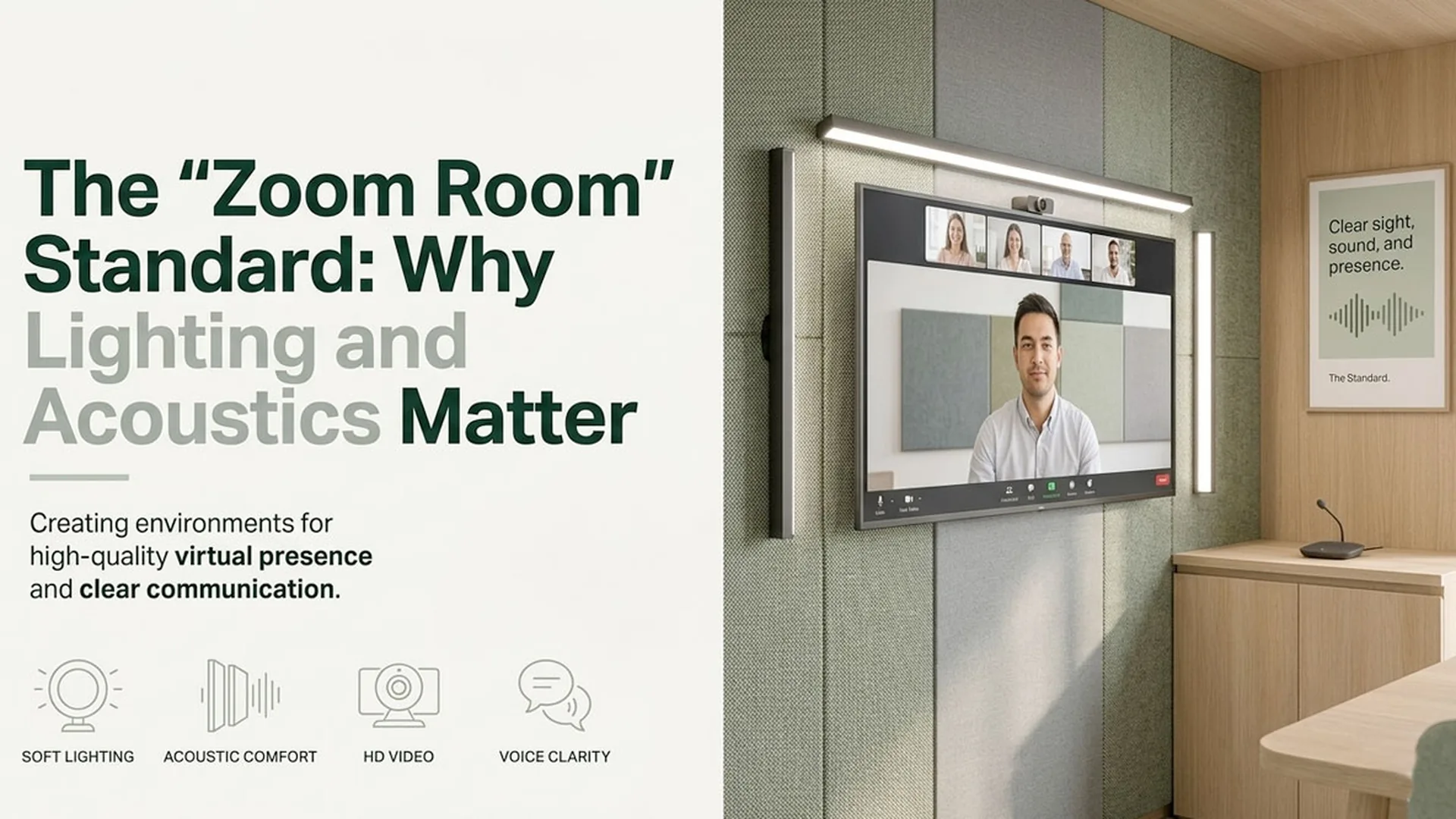
The Rise of the "Zoom Room" Standard
The pandemic accelerated remote communication almost overnight, but many office environments never fully adapted afterwards.
Most workplaces were originally designed for face-to-face interaction, not back-to-back virtual meetings. As a result, employees often find themselves taking important calls in spaces with poor lighting, distracting background noise, echo-heavy acoustics, or constant interruptions.
We've all experienced it:
- •Struggling to hear someone because of office noise
- •Sitting under harsh lighting that makes people look exhausted on camera
- •Trying to present professionally while conversations happen in the background
- •Taking client calls from kitchens, corridors, or open-plan desks
These things may seem minor individually, but together they significantly affect communication quality, professionalism, and concentration.
And in many businesses, video calls are now the primary way teams interact with clients, partners, and remote colleagues. That means the environment surrounding those calls matters far more than it used to.
Poor Acoustics Are a Bigger Problem Than Most Businesses Realise
Acoustics are still one of the most underestimated elements of workplace design.
In open offices especially, sound travels constantly. Conversations, ringing phones, keyboard noise, meetings, and background movement all compete for attention throughout the day. While employees may gradually adapt to the noise mentally, the cognitive impact remains significant.
Poor acoustics don't just create distractions. They increase mental fatigue.
The brain is forced to continuously filter unnecessary sound while trying to focus on conversations or tasks. Over time, that becomes exhausting — especially during long video meetings where concentration is already under pressure.
This is one reason why so many employees leave video-heavy days feeling unusually drained. The issue often isn't the meeting itself. It's the environment surrounding it.
That's why businesses are placing much greater emphasis on acoustic performance in modern workplaces, particularly in spaces designed for virtual communication.
Lighting Is No Longer Just an Interior Design Decision
Lighting has traditionally been viewed as a visual or aesthetic feature within offices. But in the hybrid workplace, it has become a communication tool.
Poor lighting affects:
- •On-camera professionalism and how presenters appear to clients
- •Eye strain and fatigue during long virtual meetings
- •Energy levels and focus throughout the working day
- •Overall employee comfort in the space
Natural lighting remains the gold standard wherever possible, but many offices are now also incorporating softer, more balanced lighting setups specifically designed for video calls and virtual collaboration.
Harsh overhead lighting, dark backgrounds, or inconsistent brightness can make even high-quality office spaces feel uncomfortable and unprofessional on screen.
Whether businesses like it or not, video calls have become part of their brand experience.
Clients, candidates, and remote colleagues form impressions based not only on what people say, but also on the environment they appear in. That's something many companies are only beginning to recognise.
The Shift Towards Purpose-Built Spaces
One of the biggest workplace changes happening right now is the rise of purpose-built environments for specific tasks.
Instead of expecting employees to do everything from a single desk, modern workplaces are becoming more intentional:
- •Quiet work requires focus zones
- •Collaboration requires open areas
- •Virtual meetings require private, acoustically controlled spaces
This is exactly why meeting pods and acoustic booths have become such an important part of workplace strategy.
At Social Space Solutions, we regularly speak with businesses that are trying to solve the same challenge: how do you support constant virtual communication without disrupting the wider office environment?
The answer usually isn't building more traditional meeting rooms. It's creating smaller, flexible spaces specifically designed for focused calls, virtual meetings, and hybrid collaboration.
In many ways, these spaces have become the modern equivalent of personal offices — not because people want isolation, but because they need moments of clarity and privacy throughout the day.
Hybrid Work Has Permanently Changed Office Expectations
The reality is that hybrid work isn't a temporary phase anymore.
Employees now expect workplaces to support both physical and digital collaboration seamlessly. That means offices can no longer be designed purely around appearance or desk capacity alone.
Functionality matters more than ever.
Businesses that ignore this risk creating workplaces that actively frustrate employees rather than supporting them. On the other hand, companies investing in better acoustics, lighting, and flexible meeting spaces are often seeing stronger engagement, better productivity, and improved workplace satisfaction.
The office experience has become far more intentional. People want environments that help them perform well — not spaces they have to constantly work around.
The Future Workplace Will Be Designed for Presence and Performance
One of the most interesting things about workplace design today is that visibility is no longer enough.
For years, offices were designed around presence. If employees were physically there, the workplace was considered successful.
Now, performance and experience matter far more:
- •Can employees focus properly?
- •Can they communicate clearly on every call?
- •Can hybrid meetings feel natural instead of frustrating?
- •Can the environment reduce stress rather than add to it?
These are the questions shaping the next generation of workplace design.
The best offices of the future won't simply look modern. They'll actively support the way people work today — both on screen and off it.
And increasingly, that starts with getting the fundamentals right: lighting, acoustics, privacy, and flexibility.
Continue the series
Need Help Choosing the Right Office Pod?
Our team has helped hundreds of UK businesses find the perfect workspace solutions. Get free, impartial advice tailored to your needs.
Related Articles
Employee Retention is Built on Autonomy
When companies talk about retention, the conversation usually turns to salary or perks. The strongest predictor is something far less visible: autonomy. Part 5 of our Focus-First Workplace series.
Read more
Biophilic Design: Taking the Office Outside
Most modern employees spend the majority of their day indoors, under artificial lighting. Biophilic design is changing that. Part 3 of our Focus-First Workplace series explores how natural elements are reshaping the modern office.
Read more