
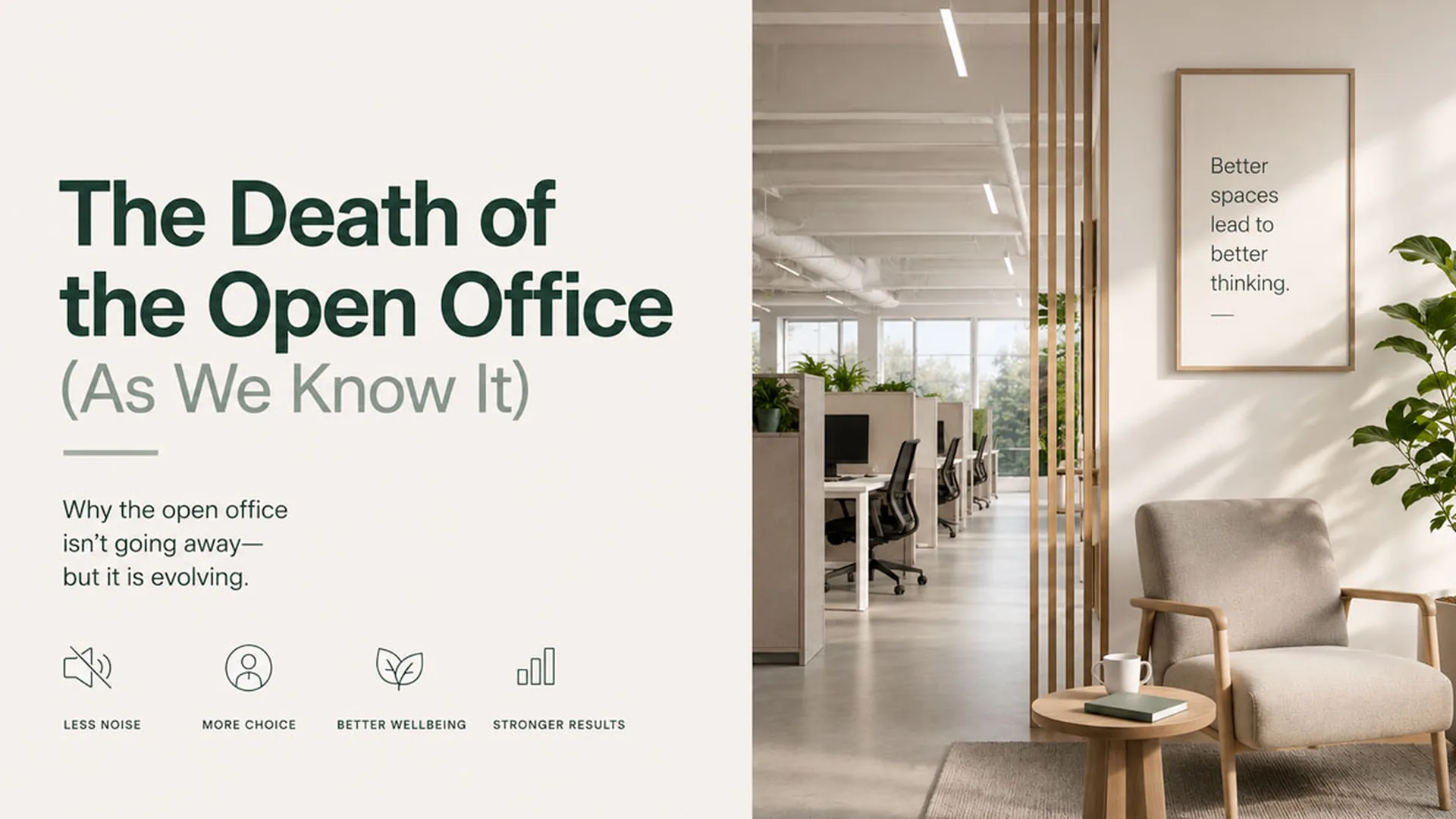
Part 1 of 5 · The Focus-First Workplace series
Last updated: May 2026 | 5 min read
For more than two decades, the open office was treated as the future of work. Walls came down, cubicles disappeared, and businesses embraced large open-plan layouts in the name of collaboration and efficiency. The idea was simple: if people sat closer together, communication and creativity would naturally improve.
But the reality hasn't always matched the vision.
Today, employees are asking for something very different from the workplace. Instead of constant interaction and busy environments, many are looking for focus, privacy, flexibility, and spaces that actually help them perform at their best. The open office isn't disappearing completely, but the era of the one-size-fits-all workplace is clearly coming to an end.
The Research Caught Up With the Idea
Research has increasingly highlighted the downsides of fully open environments. A Harvard Business School study famously found that face-to-face interaction actually decreased after open office layouts were introduced, while digital communication increased. At the same time, ongoing workplace studies continue to link noise and interruptions with lower productivity, higher stress levels, and reduced concentration.
Most people don't struggle because they lack motivation. They struggle because deep work has become incredibly difficult in environments filled with distractions.
The office itself isn't dying. Poor workplace design is.
The issue was never collaboration itself. People still value teamwork, connection, and idea sharing. The real problem is the expectation that collaboration should happen constantly throughout the day. There's a major difference between intentional collaboration and uninterrupted exposure to noise and activity.
That distinction is shaping the future of workplace design.
Designing for Flexibility, Not Uniformity
The most effective offices today are being designed around flexibility rather than uniformity. Instead of rows of identical desks, businesses are creating different zones for different types of work:
- •Quiet focus areas for deep, uninterrupted thinking
- •Collaboration spaces for whiteboarding, workshops and team rituals
- •Meeting pods and acoustic booths for calls and small group discussions
- •Informal lounges for breaks, ideation and 1:1 catch-ups
- •Private spaces for client calls and virtual meetings
The office is evolving into an ecosystem where employees can choose the environment that best suits the task in front of them.
The Hybrid Shift Changed Expectations
This shift accelerated dramatically with hybrid work. After working remotely, employees became far more aware of what helps them focus and work effectively. When they return to the office, they expect more than just a desk and Wi-Fi connection. They expect a workplace that offers value beyond what they already have at home.
That's one reason office pods and booths have become increasingly important. A few years ago, they were viewed as optional extras. Today, they are quickly becoming essential infrastructure for businesses trying to balance collaboration with concentration.
At Social Space Solutions, we see this conversation happening across almost every industry. Companies are no longer asking how to fit more desks into a floorplan. They're asking:
- •How do we make the office more productive?
- •How do we support both teamwork and focus?
- •How do we create environments employees actually want to use?
The answers usually come back to one thing: intentional design.
What the Future Workplace Actually Looks Like
The future workplace isn't fully open or fully closed. It's flexible, adaptable, and built around human performance rather than simple desk density. Acoustics matter. Privacy matters. Lighting matters. And employee autonomy matters more than ever.
Businesses that understand this are moving away from the "always-on" office and toward a more balanced model that gives employees greater control over how they work. In many ways, the future office is less about where people sit and more about how the environment supports different modes of work throughout the day.
And perhaps that's the real evolution of the modern workplace.
Continue the series
Need Help Choosing the Right Office Pod?
Our team has helped hundreds of UK businesses find the perfect workspace solutions. Get free, impartial advice tailored to your needs.
Related Articles
Employee Retention is Built on Autonomy
When companies talk about retention, the conversation usually turns to salary or perks. The strongest predictor is something far less visible: autonomy. Part 5 of our Focus-First Workplace series.
Read more
The "Zoom Room" Standard: Why Lighting and Acoustics Matter
Today's modern workplace isn't just a physical environment — it's a broadcast environment. Part 4 of our Focus-First Workplace series on why lighting, acoustics and purpose-built video spaces are now business-critical.
Read more