
Part 3 of 5 · The Focus-First Workplace series
Last updated: May 2026 | 6 min read
For years, workplace design focused heavily on efficiency.
More desks. More meeting rooms. More people fitted into the same square footage. Offices became highly functional environments built around productivity, collaboration, and technology.
But somewhere along the way, many workplaces lost something important: a connection to the natural world.
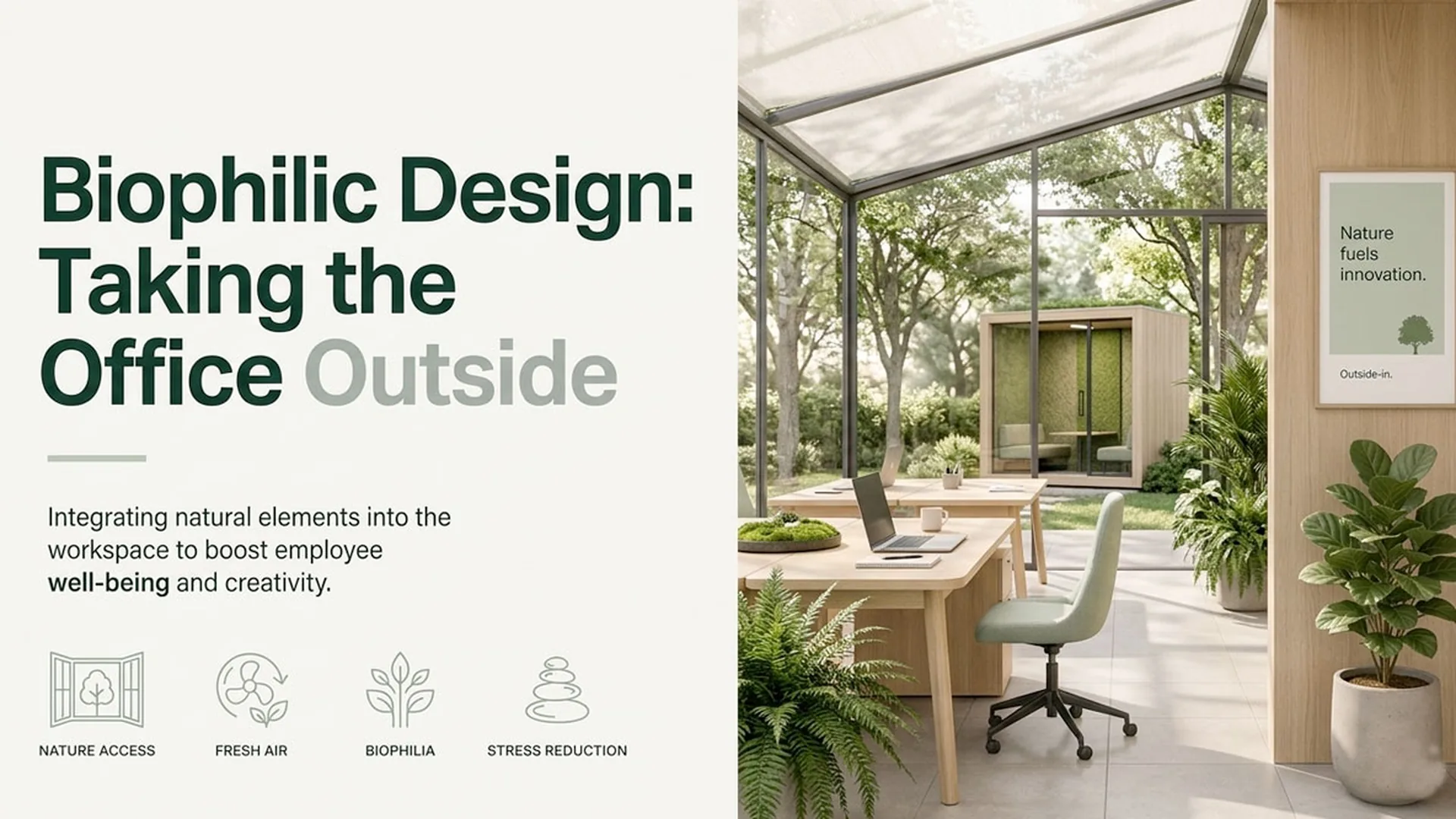
That's exactly why biophilic design has become one of the most influential workplace trends in recent years. At its core, biophilic design is about bringing elements of nature into the workplace — not simply for aesthetics, but to improve wellbeing, focus, creativity, and overall employee experience.
And as businesses rethink what makes people actually want to come into the office, this conversation is becoming increasingly important.
The Workplace Doesn't Need to Feel Artificial
Most modern employees spend the majority of their day indoors, under artificial lighting, surrounded by screens, noise, and constant digital stimulation.
It's no surprise that many workplaces can begin to feel mentally draining over time.
Biophilic design challenges that environment by introducing more natural materials, greenery, daylight, textures, and organic spaces into office design. The goal isn't to make offices look like jungles. It's to create environments that feel calmer, healthier, and more human.
Research continues to support the impact this can have. Studies have linked exposure to natural elements in workplaces with:
- •Reduced stress levels
- •Improved concentration and productivity
- •Better employee wellbeing
- •Increased creativity and idea generation
- •Higher workplace satisfaction scores
And in a hybrid work era, employee experience matters more than ever.
The office is no longer competing with other offices. In many ways, it's competing with home.
Why Employees Gravitate Towards Natural Spaces
It's interesting to observe where people naturally choose to work when given the option.
In many offices, breakout areas with natural light, softer furnishings, plants, and quieter surroundings consistently become the most popular spaces in the building. Employees instinctively gravitate toward environments that feel comfortable and calming.
That behaviour says a lot about what people need from modern workplaces. For decades, many offices prioritised corporate appearance over human comfort. Clean lines, bright lighting, hard surfaces, and minimalist layouts often looked impressive but didn't always create environments where people felt relaxed or focused.
Biophilic design shifts the emphasis back toward the employee experience. It recognises that people generally work better when spaces feel less clinical and more connected to the outside world.
It's About More Than Just Plants
One of the biggest misconceptions about biophilic design is that it simply means adding a few plants around the office.
In reality, it's far broader than that. Modern biophilic workplaces often incorporate:
- •Natural lighting wherever possible
- •Timber, stone, and textured materials instead of hard plastic and glass
- •Acoustic treatments that soften noise
- •Organic shapes and softer, less rigid layouts
- •Green walls and indoor planting at scale
- •Outdoor working areas and terraces
- •Better airflow and ventilation
- •Quiet wellness or recharge spaces
Some of the best workplace environments now blur the line between indoors and outdoors entirely.
This trend is particularly visible in tech-forward and future-focused workplaces where employee wellbeing is viewed as a business advantage rather than simply a design feature.
Because ultimately, the physical environment influences how people feel, think, and perform throughout the day.
The Rise of "Destination Offices"
Biophilic design is also connected to another major workplace shift: the rise of the destination office.
If employees can work from home several days a week, the office needs to offer something valuable in return. Businesses are increasingly recognising that people won't commute simply to sit at a desk they could access remotely. The modern office has to provide a better experience.
That's why we're seeing more workplaces designed around hospitality-style thinking:
- •Softer environments that feel less corporate
- •Lounge and café-style collaboration areas
- •Wellness and recharge rooms
- •Outdoor meeting spaces
- •Quiet pods for focused work
- •Flexible work settings across the floorplan
The best offices no longer feel purely corporate. They feel intentional.
At Social Space Solutions, we've noticed that many businesses are becoming far more conscious of how workplace environments affect employee energy and behaviour. The conversation has moved well beyond furniture selection alone. Companies are now asking how their office can support wellbeing, focus, retention, and culture simultaneously.
And increasingly, natural design plays a major role in that conversation.
Acoustics, Privacy, and Wellbeing Are Connected
One interesting part of biophilic design that often gets overlooked is its relationship with acoustics and mental fatigue.
Nature-inspired environments tend to prioritise calmness and sensory balance. That means reducing harsh noise, improving privacy, and creating spaces where employees can mentally reset during the day.
This is one reason acoustic booths and pods fit naturally into modern biophilic workplaces. While they solve practical challenges around meetings and focus, they also help create quieter, lower-stress environments within busy offices.
The future workplace isn't just about visual design. It's about how the environment feels psychologically.
And employees notice the difference immediately.
The Future Workplace Will Feel More Human
For a long time, workplace design was centred around operational efficiency above everything else.
Today, businesses are recognising that employee performance and wellbeing are closely connected. People generally produce better work when they feel comfortable, energised, and supported by their environment.
That doesn't mean every office needs waterfalls and rooftop gardens. But it does mean the future workplace will likely feel warmer, softer, greener, and far more adaptable than the corporate environments of the past.
Biophilic design isn't simply a trend driven by aesthetics. It reflects a wider shift in how businesses think about work itself.
The goal is no longer just fitting people into a space. It's creating spaces where people can genuinely thrive.
Continue the series
Need Help Choosing the Right Office Pod?
Our team has helped hundreds of UK businesses find the perfect workspace solutions. Get free, impartial advice tailored to your needs.
Related Articles
Employee Retention is Built on Autonomy
When companies talk about retention, the conversation usually turns to salary or perks. The strongest predictor is something far less visible: autonomy. Part 5 of our Focus-First Workplace series.
Read more
The "Zoom Room" Standard: Why Lighting and Acoustics Matter
Today's modern workplace isn't just a physical environment — it's a broadcast environment. Part 4 of our Focus-First Workplace series on why lighting, acoustics and purpose-built video spaces are now business-critical.
Read more